List
- Iterable: allow using with for each loop.
- Fail-fast iterator: concurrent modification by multiple threads will throw ConcurrentModificationException.
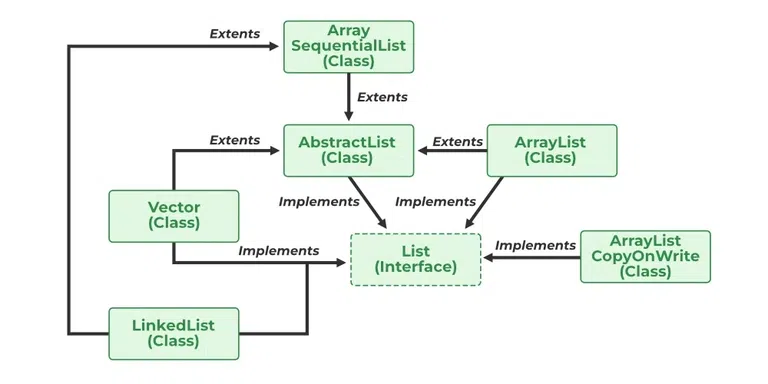
- ArrayList: dynamic array.
- Slower than standard array (resizing operation copies all of the elements)
- Similar to vector in C-C++.
- Not synchronized in multi-thread environment. Use CopyOnWriteArrayList or Vector if we want synchronization.
- CopyOnWriteArrayList: clone the array before perform operations, only good for read operation.
- Vector: implements List interface and has some legacy methods.
- Stack: a subclass of Vector that implements the stack data structure.
- LinkedList: implemented using double linked list data structure.
- Also support methods with index (because it implements AbstractList).
- Slower than ArrayList when it comes to accessing individual elements.
- Requires additional memory for pointer.
Map
- Interfaces: Map and SortedMap.
- Implementations: HashMap, LinkedHashMap, TreeMap.
- Can not contain duplicate elements.
- Allows null key and null value: HashMap and LinkedHashMap.
- Maintains orders of insertion: TreeMap and LinkedHashMap.
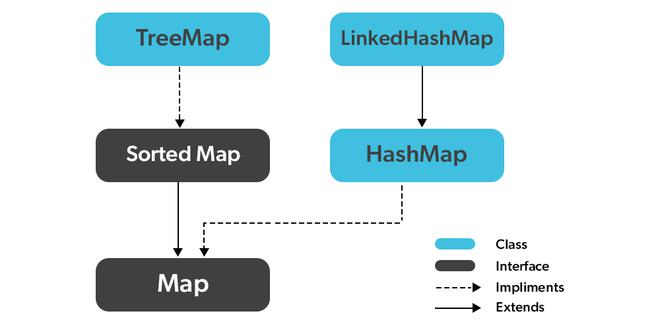
- HashMap:
- Unsorted.
- Unsynchronized. Solution:
Collections.synchronizedMap(new HashMap(...)). - Only one null key.
- Implemented using linked list. Each node has 4 fields:
int hash,K key,V value,Node next.
- TreeMap:
- Sorted according to the natural ordering of keys or by a pre-defined Comparator.
- Unsynchronized. Solution:
Collections.synchronizedSortedMap(new TreeMap(...)). - Not allow null keys, but multiple null values can be associated with different keys.
- Implemented using a Red-Black tree (a type of self-balacing binary search tree). Each node in the tree has:
- 3 Variables (K key=Key, V value=Value, boolean color=Color)
- 3 References (Entry left = Left, Entry right = Right, Entry parent = Parent)
- LinkedHashMap: an extension of HashMap and
- Elements can be accessed by insertion order (need more CPU and memory).
- Unsynchronized. Solution:
Collections.synchronizedMap(new LinkedHashMap(...)). - Implemented using doubly-linked list. Each node has the following fields:
hash(to make search and insert operation faster),before,key,valueandafter(for retrieving elements in insertion order).
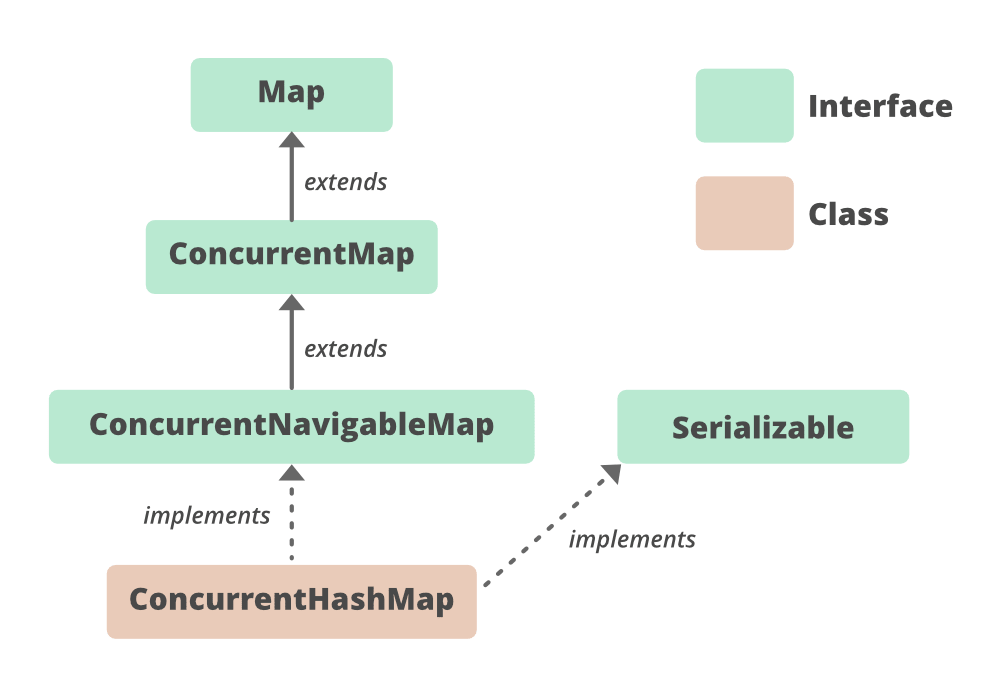
- ConcurrentHashMap: better choice when there are more reads than writes.
- Uses HashTable as underlying data structure.
- Divides object into 16 segments (16 is called concurrency-level and it is default value) and lock the particular segment when a thread performs update operation on that segment.
- At a time, 16 update operations can be performed by threads.
- This is called segment locking or bucket locking.
- Not allow null keys and null values.
- HashTable: a legacy class in which all methods are synchronized using
synchronizedkeyword.
Set
- All the classes of the Set interface are internally backed up by Map.
- Only need to pass a value instead of key-value pair. The value acts as the key and for its value, Java use a constant variable. So in the key-value pair, all the values will be the same.
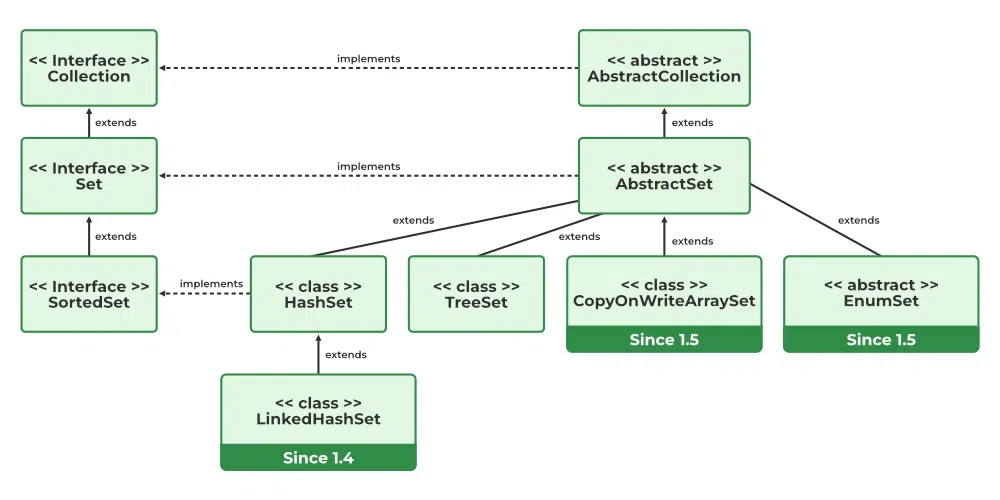
- HashSet
- Order of elements is not guaranteed.
- Null elements are allowed.
- Duplicate values are not allowed.
- Implemented using HashMap.
- LinkedHashSet:
- Maintains insertion order (need more CPU and memory).
- Extends HashSet but uses doubly-linked list across all elements.
Difference between LinkedHashMap and LinkedHashSet:
| Categories | LinkedHashMap | LinkedHashSet |
|---|---|---|
| Operation | Used to store key-value pairs. | Used to store collection of things |
| Duplicates | Take unique and no duplicate keys but can take duplicate values | Stores no duplicate element |
| Implements | HashMap | HashSet |
| Example | Map<String, Integer> lhm = new LinkedHashMap<String, Integer>(); | Set<String> lhs = new LinkedhashSet<String>(); |
- SortedSet:
- All of the elements must implement Comparable interface and must be mutually comparable (two objects accepts each other as the argument to their
compareTomethod).
- All of the elements must implement Comparable interface and must be mutually comparable (two objects accepts each other as the argument to their
- NavigableSet: implementation of SortedSet for navigating through the set.
- TreeSet:
- Objects are stored in sorted and ascending order. We also can iterate in descending order.
- Implementation of NavigableSet.
- Implemented using self-balancing tree.

Queue
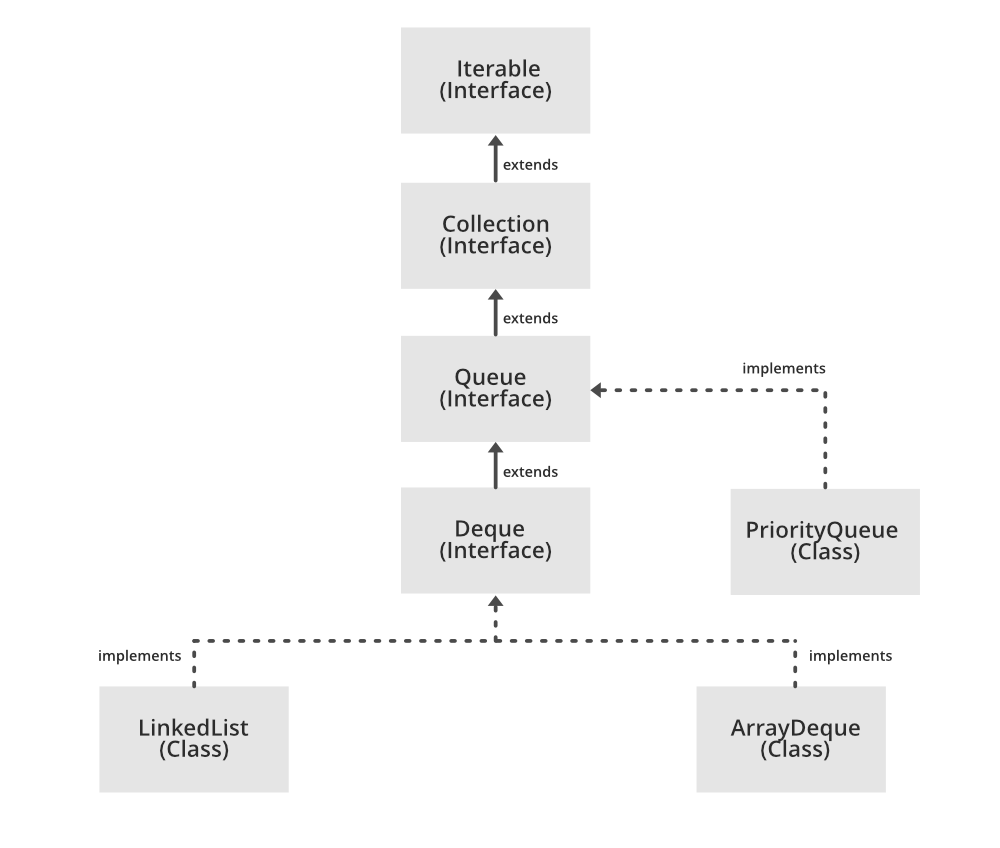
- PriorityQueue:
- Elements are ordered by
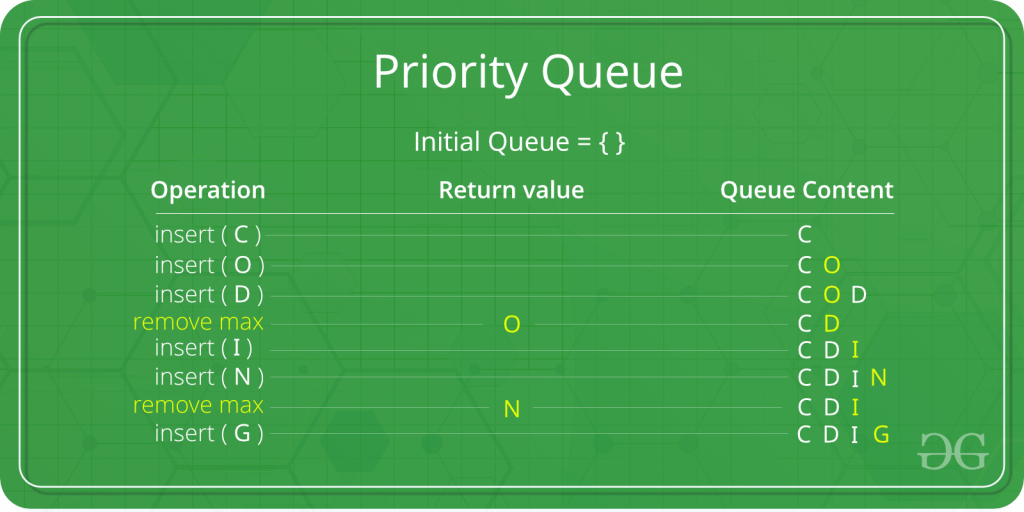
- Natural ordering (an element with a maximum ASCII value will have the highest priority).
- A pre-defined comparator.
- Not allow null values.
- Is not thread-safe.
- Implemented using priority heap.
- Elements are ordered by
Example:
- PriorityBlockingQueue:
- Uses the same ordering rules as PriorityQueue.
- Not allow null values.
- Thread-safe.